The Science Behind CallMap's AI Sales Coaching
At CallMap, we've built a sales coaching system that learns from your team's most successful conversations and applies those learnings to help every rep improve. But how does it actually work? Let's dive into the science behind our AI-powered coaching engine.
The Core Principle: Learn from Success, Apply to Growth
Traditional sales coaching relies on generic best practices or one-size-fits-all advice. Our approach is fundamentally different: we mine patterns from your actual high-outcome calls and use machine learning to apply those patterns to improve future conversations.
This means your coaching isn't based on what works in theory—it's based on what works for your team, your product, and your customers.
Phase 1: Pattern Mining from High-Outcome Calls
Identifying What Works
The foundation of our coaching system is pattern mining. Here's how it works:
- Outcome-Based Selection
We analyze all sales calls in your workspace and identify those with high outcome scores (typically 0.7 or above on a 0-1 scale). These are your winning calls—the ones that led to closed deals, strong next steps, or positive customer engagement. - Conversational Pattern Extraction
For each high-outcome call, our ML system analyzes the transcript to identify effective conversational patterns. We look for patterns across nine key categories:- Objection Handling: How successful reps address concerns
- Price Framing: Effective ways to discuss pricing
- Closing Language: Phrases that advance deals
- Urgency Creation: How top performers create momentum
- Empathy Signals: Ways to show understanding
- Discovery Questions: Questions that uncover needs
- Rapport Building: Techniques that build connection
- Value Proposition: How value is communicated
- Social Proof: Use of testimonials and examples
- Pattern Validation
Each extracted pattern is scored based on its correlation with positive outcomes. Patterns that appear frequently in high-outcome calls receive higher effectiveness scores. - Storage and Organization
These patterns are stored in your workspace's pattern library, creating a knowledge base that grows with every successful call. Patterns can be workspace-specific (learned from your team) or global (learned across all CallMap users).
Why This Matters
Instead of guessing what works, we let the data speak. If a particular objection-handling technique appears in 80% of your closed deals, that's a pattern worth teaching. If a pricing discussion approach correlates with higher deal values, that becomes part of your coaching curriculum.
Phase 2: Intelligent Coaching Generation
From Patterns to Personalized Feedback
Once we have a library of proven patterns, we use them to generate coaching for any sales call. Here's the process:
Step 1: Sales Person Identification
Before we can coach effectively, we need to know who said what. Our ML system identifies the sales person using multiple signals:
- Role Hints: Participants marked as "host" or "internal"
- Workspace Membership: Team members associated with your workspace
- Call Creator: The person who uploaded or created the call
- Speaker Analysis: When speaker labels are ambiguous, we use natural language processing to distinguish between sales person and customer dialogue
This ensures we're only coaching the sales person's responses, not analyzing customer statements.
Step 2: Key Moment Extraction
Not every part of a call needs coaching. We use ML to identify the most important moments:
- Segment Extraction
We break the transcript into conversational segments, each associated with a speaker. - Sales Person Filtering
We filter to only include segments spoken by the identified sales person. - Moment Tagging
Our ML system tags segments by type:- Objection handling moments
- Pricing discussions
- Closing attempts
- Discovery questions
- Rapport building
- Priority Selection
We select the top 4-5 moments that represent the highest-impact coaching opportunities—typically objection handling, pricing discussions, and closing moments.
Step 3: Context-Aware Coaching
For each key moment, we provide:
- Customer Context: What the customer said before the sales person's response. This provides crucial context for understanding why a particular response was needed.
- Original Response: The sales person's actual verbatim response.
- Improved Response: A rewritten version that applies proven patterns from your high-outcome calls.
- Explanation: Why the improved version works better, referencing specific patterns and techniques.
- Pattern Tags: Which patterns from your library were applied (e.g., "objection_handling" + "empathy_signal").
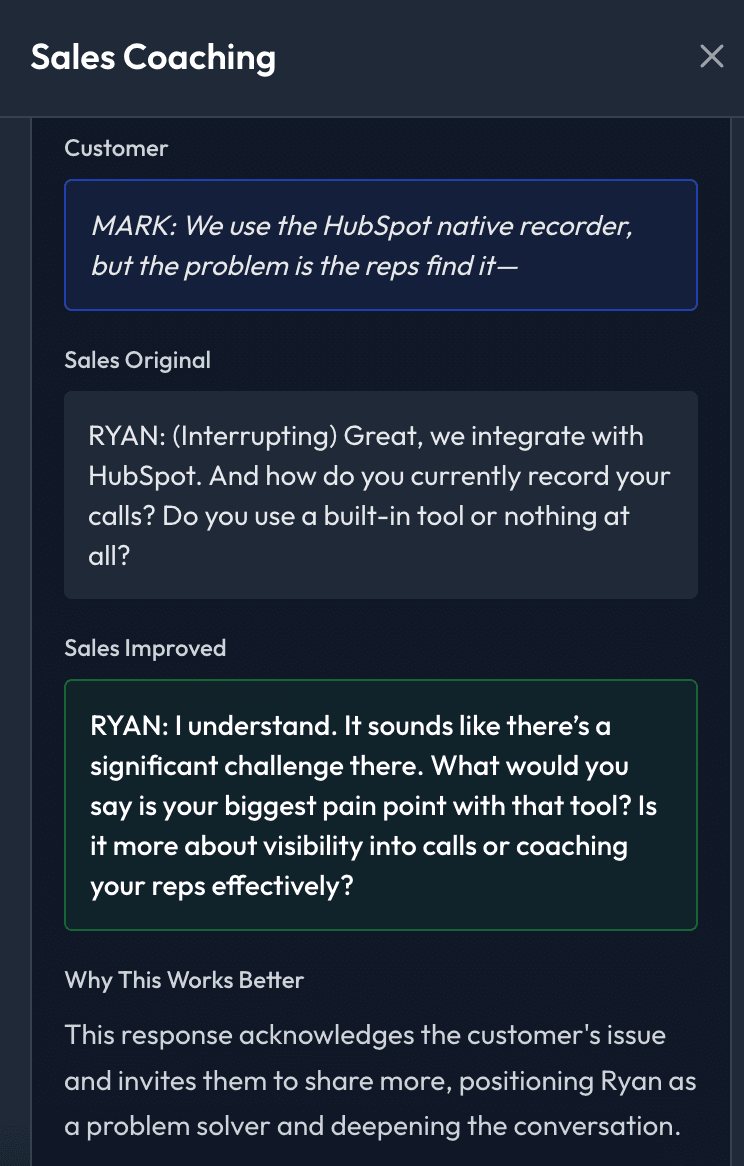
Example of a coaching moment showing customer context, original response, improved response, and explanation
The LLM's Role
Our CallMap LLM (Large Language Model) doesn't generate coaching from scratch. Instead, it acts as a pattern application engine:
- Input: Sales person's original response + customer context + your proven patterns
- Process: The LLM analyzes the original response and rewrites it using relevant patterns from your pattern library
- Output: An improved response that applies what works in your successful calls
This is the key difference: we're not asking an AI to invent coaching advice. We're asking it to apply your team's proven patterns to improve specific moments in a call.
The Science: Why This Approach Works
1. Domain-Specific Learning
Generic sales advice often fails because it doesn't account for your specific product, market, or customer base. By learning from your actual successful calls, our patterns are inherently relevant to your context.
2. Outcome Correlation
Every pattern in our system is scored based on its correlation with positive outcomes. If a technique appears in high-outcome calls, it gets a high effectiveness score. This creates a feedback loop: the more successful calls you have, the better your coaching becomes.
3. Contextual Application
We don't just identify patterns—we apply them contextually. The same objection-handling pattern might be applied differently depending on:
- What the customer said (the context)
- The stage of the conversation
- The type of objection
- The overall call outcome
4. Continuous Improvement
As your team generates more high-outcome calls, your pattern library grows. This means:
- More patterns to choose from
- Better pattern effectiveness scores
- More nuanced coaching over time
Your coaching system gets smarter with every successful call.
Technical Architecture: Efficiency and Scalability
Caching for Performance
Coaching generation is computationally intensive, so we've built a smart caching system:
- 7-Day Cache: Coaching results are cached for 7 days or until the mindmap is updated
- Automatic Invalidation: If a call is re-analyzed or updated, the cache is invalidated
- Cost Efficiency: Caching reduces LLM API calls while ensuring fresh coaching when needed
Pattern Deduplication
As patterns are mined from multiple calls, we deduplicate similar patterns:
- Patterns with the same type and similar examples are merged
- Usage counts are aggregated (showing how many calls used this pattern)
- Effectiveness scores are updated based on the highest outcome correlation
This ensures your pattern library stays clean and focused on what works.
Workspace vs. Global Patterns
- Workspace Patterns: Learned from your team's calls, these are specific to your product, market, and sales style
- Global Patterns: Learned from all CallMap users, these provide a broader knowledge base
The system intelligently combines both, prioritizing workspace patterns when available but falling back to global patterns for broader coverage.
Real-World Impact
What This Means for Your Team
- Personalized Coaching
Every rep gets coaching based on what works for your specific team and product. - Actionable Feedback
Instead of vague advice like "be more consultative," reps see specific improvements: "Here's what you said, here's how to say it better using a pattern from Sarah's closed deal last month." - Learning from Top Performers
When your top rep closes a deal, their techniques become teachable patterns for the rest of the team. - Contextual Learning
Reps see not just what to say, but when to say it—complete with customer context. - Continuous Improvement
As your team improves, your coaching improves, creating a positive feedback loop.
The Future: Where We're Heading
Our coaching system is designed to evolve. As we continue to develop the platform, we're exploring:
- Real-Time Coaching: Providing suggestions during live calls
- Pattern Effectiveness Tracking: Measuring which patterns lead to the best outcomes over time
- Team-Specific Pattern Libraries: Allowing teams to curate and share their best patterns
- Advanced Context Understanding: Better recognition of conversation stages, customer sentiment, and deal progression
Conclusion: Science Meets Practice
At CallMap, we believe the best sales coaching comes from learning what actually works, not what should work in theory. By combining pattern mining from high-outcome calls with intelligent LLM-based coaching generation, we've created a system that gets smarter with every successful call.
The science is simple: learn from success, apply to growth. The result is coaching that's personalized, actionable, and continuously improving—exactly what your team needs to close more deals.
Want to see CallMap's AI sales coaching in action? Try it free and watch your team's best calls become your coaching curriculum.